Reeds for a reed diffuser, which kind, how many and when to change them
The sticks do the work; a reed diffuser is only as good as the reeds in it. Most sets come with natural rattan, which has fine channels along its length; man-made fibre reeds are the uniform alternative. Pick a length that stands well clear of the neck, start with a few, flip them when the scent fades and fit a fresh bundle once they stop carrying.
By the editors of Aromatherapy Oil DiffuserUpdated 21 October 20265 min read
In short
- Rattan is the natural stick with channels that wick; fibre is a uniform man-made stick sold on free wicking.
- The reed must stand clearly above the neck and reach the liquid; more reeds mean more scent and a sooner-empty bottle.
- Flip when the scent fades, replace when a flip no longer helps, and never move a used reed to a new scent.
Rattan or fibre, and what each kind is known for
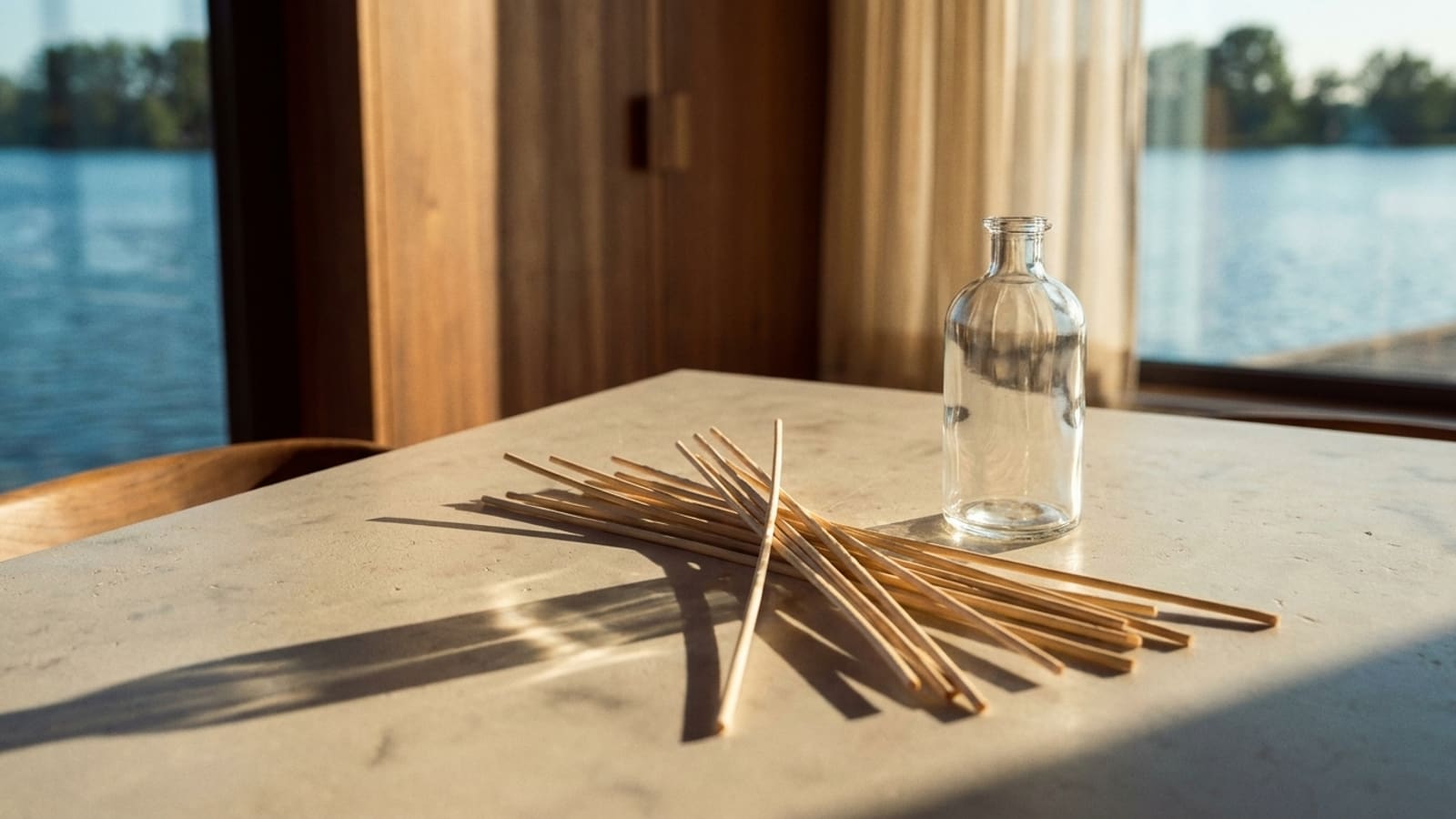
A natural reed is a length of rattan, a climbing palm, cut and dried. Fine channels that carried sap in the living plant run its whole length, and they draw the liquid up from the bottle. No two sticks are quite alike: one wicks a little faster, one has a kink, one is a touch thicker.
| Rattan reed | Fibre reed | |
|---|---|---|
| What it is | A dried natural stick with channels along it | Pressed man-made strands, even throughout |
| Look | Pale and slightly uneven, with a natural grain | Smooth and uniform, often black or coloured |
| Sold on | Low cost; in nearly every set | Free wicking; said to suit thicker liquids |
| Watch for | Variation between sticks, the odd dud | Can wick fast and empty a bottle sooner |
Length, thickness and how many to stand in the bottle
The scent leaves from the part of the reed that stands in the air, so the length above the neck is what matters. It should stand clearly above the bottle and reach its base with ease, because as the bottle empties the liquid has further to climb.
Thickness is about the neck: the bundle must pass through with room to spare, while very thin reeds slump as they soften and carry less. More reeds means more wet surface in the air, more scent and a faster-emptying bottle.
- A downstairs loo or a hallway corner: a few reeds, spaced out in the neck.
- A bedroom: fewer still, and a soft scent; a strong one is hard to sleep beside.
- A larger or busier room: as many as the neck will take, and a bottle that empties sooner.
The limit is the neck. Once the sticks press together they stop acting as separate reeds; liquid creeps up between them, smells strong beside the bottle rather than across the room, and drips run down the glass. Fan them out so each stick stands alone. If you keep adding reeds and the room still wants more, our comparison of diffusers with a timer and a stated room size starts from the room rather than the stick.
Flipping, and what it actually does
Turning a reed over puts the saturated end into the air and the drier end into the liquid. The air gets a fresh load of fragrance at once, which is the burst you notice, and then the stick settles back to its slow, steady pace. Flipping adds no scent to the bottle; it moves what is already in the stick to where the air can reach it.
Do it when the scent fades, not by the calendar, and over the sink because the wet end drips. Each flip also sends the dusty end down into the liquid. Wash your hands afterwards.
Why a reed clogs, when to replace it and what a used one cannot do
A reed carries two things up its channels: a thin base that evaporates, and the fragrance, which is heavier and does not all leave. The residue dries inside the channels and narrows them. The stick darkens, may feel tacky, and the level in the bottle stops dropping. A wash will not reach the channels, so replace the bundle when a flip no longer brings a burst.
Loose reeds are sold in bundles, rattan and fibre, in several lengths and thicknesses; measure the bottle and its opening before ordering. What you cannot do is move a used reed to a new scent. Its channels are full of the old fragrance, and a new liquid carries the old one up with it. Give any new liquid a fresh bundle.
If you are tired of blaming the reeds one week and the liquid the next, our guide to the machines that scent a room without a stick or a flame shows what a device with a dial gives you instead.
Where a stick stops and a machine takes over
A reed has no switch. It gives the room the same slow trickle when you are in it, asleep or away, and in a large or open room the scent stays near the bottle however many sticks you stand in it.
When those limits are the problem, the answer is a device that runs on a bottle of oil or a pod and comes on when you want it. The page where we weigh a bottle of oil against a pod gives the running cost of each.
Ready for something with a switch?
Our homepage compares the diffusers that run on oil or a pod, with stated reach and monthly cost.